Accra’s Endless Floods: A 70‑Year Failure — And Why Blaming Citizens Is a Political Evasion
Accra’s Endless Floods: A 70‑Year Failure — And Why Blaming Citizens Is a Political Evasion
Introduction: A Disaster Older Than Most Ghanaians
Accra has flooded for over seven decades. Not once. Not occasionally. But every single year, with deadly consequences.
This is not a mystery. This is not an accident. And it is certainly not the fault of ordinary citizens, no matter how many presidents attempt to shift blame.
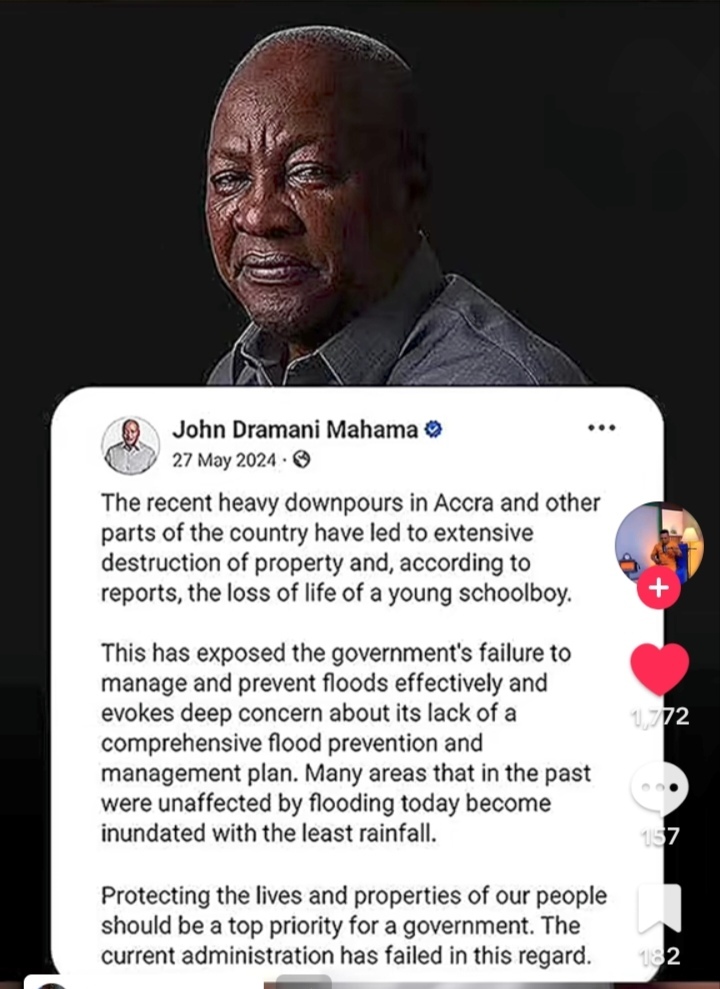
Yet in 2024, election year, he blamed NPP. However, now in 2026, President John Dramani Mahama publicly suggested that citizens were responsible for the devastation — framing them as careless, irresponsible, or negligent.
This narrative is not only misleading. It is dangerous, politically convenient, and contradicted by every major engineering, environmental, and urban‑planning study ever conducted on Accra.
This article breaks down the real causes, the political blame game, and why Ghana deserves better than recycled excuses.
Continue ReadingAccra’s flooding is not new. It predates every modern political party, every current leader, and every contemporary urban settlement pattern.
Major flood years include:
1959
1968
1995
2001
2010
2015 (the catastrophic flood + GOIL explosion killing 150+)
2020–2026 (annual severe flooding)
For 70+ years, the pattern has been identical:
Heavy rain + inadequate drainage + blocked waterways + uncontrolled construction = disaster.
This is not a behavioral issue. It is a structural engineering failure.
2. What the Evidence Actually Shows
Every credible institution — NADMO, EPA, Accra Metropolitan Assembly, hydrologists, urban planners, and international development agencies — agrees on the real causes:
A. Undersized and outdated drainage
Accra’s drains were designed for a city of 50,000 people. Today the metro area has over 5 million.
B. Wetland destruction
Between 2008–2018, satellite data shows massive encroachment on natural flood plains.
C. Weak enforcement of building codes
52% of surveyed households cite government failure to enforce regulations as the main cause of flooding.
D. No correlation between rainfall and flood severity
Some years with less rainfall produced more flooding — proving the issue is infrastructure, not nature.
E. Mismanaged or stalled flood‑control projects
The GARID project (Greater Accra Resilient Integrated Development) received:
$200 million (World Bank)
+ $150 million (additional funding approved by Parliament)
Yet little visible progress exists on the ground.
3. The Political Blame Game: A Convenient Distraction
When leaders face a long‑standing national problem, they have two choices:
Own the responsibility and fix it, or
Blame the public.
Years back, as in power and again in 2026, President Mahama chose option 2.
2024 it was the NPP fault {Well, well... ELECTION year!)
What he said
Mahama suggested that citizens’ behavior — waste disposal, construction choices, and “irresponsibility” — contributed significantly to the floods.
Why this is misleading
Because:
Citizens do not design drainage systems.
Citizens do not approve building permits.
Citizens do not enforce zoning laws.
Citizens do not manage flood‑control budgets.
Citizens do not award contracts for storm drains.
Flooding is a governance problem, not a cultural one.
Why this narrative is politically useful
Blaming citizens:
Deflects accountability
Avoids scrutiny of failed projects
Rewrites history
Creates a moral distraction
Turns a structural problem into a behavioral one
But it does not solve anything.
4. The GARID Controversy: Millions Spent, Little Delivered
The GARID project was supposed to:
Expand major drains
Clear waterways
Build retention ponds
Improve waste management
Reduce flood risk for 1.3 million people
Instead, the public sees:
Delayed works
Incomplete drains
Poor maintenance
No measurable reduction in flooding
Even former officials and engineers have questioned where the money went.
5. Why Blaming Citizens Is Not Just Wrong — It’s Harmful
When leaders blame citizens for systemic failures:
Real solutions are delayed
Funds are misallocated
Public trust collapses
Accountability disappears
The cycle repeats
Accra cannot afford another 70 years of excuses.
6. What Ghana Actually Needs
A. A modern drainage master plan
Designed for a 21st‑century city, not a 1950s town.
B. Enforcement of building codes
No more political protection for illegal construction.
C. Transparent infrastructure spending
Every cedi accounted for.
D. Wetland restoration
Nature is the cheapest flood‑control system.
E. A government that accepts responsibility
Not one that shifts blame to the very people suffering the consequences.
Conclusion: Ghana Deserves Leadership, Not Excuses
Accra’s floods are not caused by “dirty” or “irresponsible” citizens. They are caused by decades of political neglect, poor engineering, and failed urban planning.
When a president blames the people instead of fixing the system, it is not leadership — it is evasion.
Ghanaians deserve a government that:
Builds
Maintains
Enforces
Plans
Protects
Not one that lectures, deflects, or scapegoats.
Accra’s flooding is solvable. But only when leaders stop blaming the victims and start addressing the real causes.
Sources & References
World Bank — Greater Accra Resilient and Integrated Development Project (GARID)
Ghana Meteorological Agency — Rainfall & flood correlation data
NADMO annual flood reports
EPA Ghana — Wetland encroachment studies
Accra Metropolitan Assembly — Urban planning & drainage assessments
JoyNews, CitiNewsroom, Graphic Online — Reporting on 2024–2025 flood responses
Academic studies on Accra flooding (University of Ghana, KNUST, UN‑Habitat)