Blasting the North: Mahama's Rock-Gold Plan for Upper East and the Landscape It Would Take
Ghana 2026 · Mining · Heritage · No sugar coating
Blasting the North: Mahama's Rock-Gold Plan for Upper East and the Landscape It Would Take
The President says gold in the Upper East sits in rock, so blasting it out does less damage than galamsey in the southern forests. Anyone who has walked the granite country around Tongo, Tengzug and Bongo knows the problem with that sentence: up there, the rock is the landscape.
What the President said
In August 2026, on his "Resetting Ghana" tour of the Upper East Region, President John Dramani Mahama spoke about gold. He spoke about illegal miners who get chased from one forest reserve and simply move to the next. He announced that soldiers would now stay inside cleared reserves because the forest guards are too easily driven off.
And then he turned to the region he was standing in.
He went on to describe the process himself. The rock is blasted, the rock is processed, and the gold is taken out. That, he said, does not cause the kind of destruction seen in the forests of the south, and he called it a fortunate thing. He added that Upper East has good potential, that mining can give young people jobs, and that the goal is formal, controlled mining rather than scattered illegal pits.
Read that again slowly. The head of state stood in one of the most distinctive landscapes in West Africa and described blasting it as the lucky option.
A landscape made of rock
I know the Upper East. I have travelled it, photographed it and written about it for more than two decades. This section is my own first-hand account, and I say so openly.
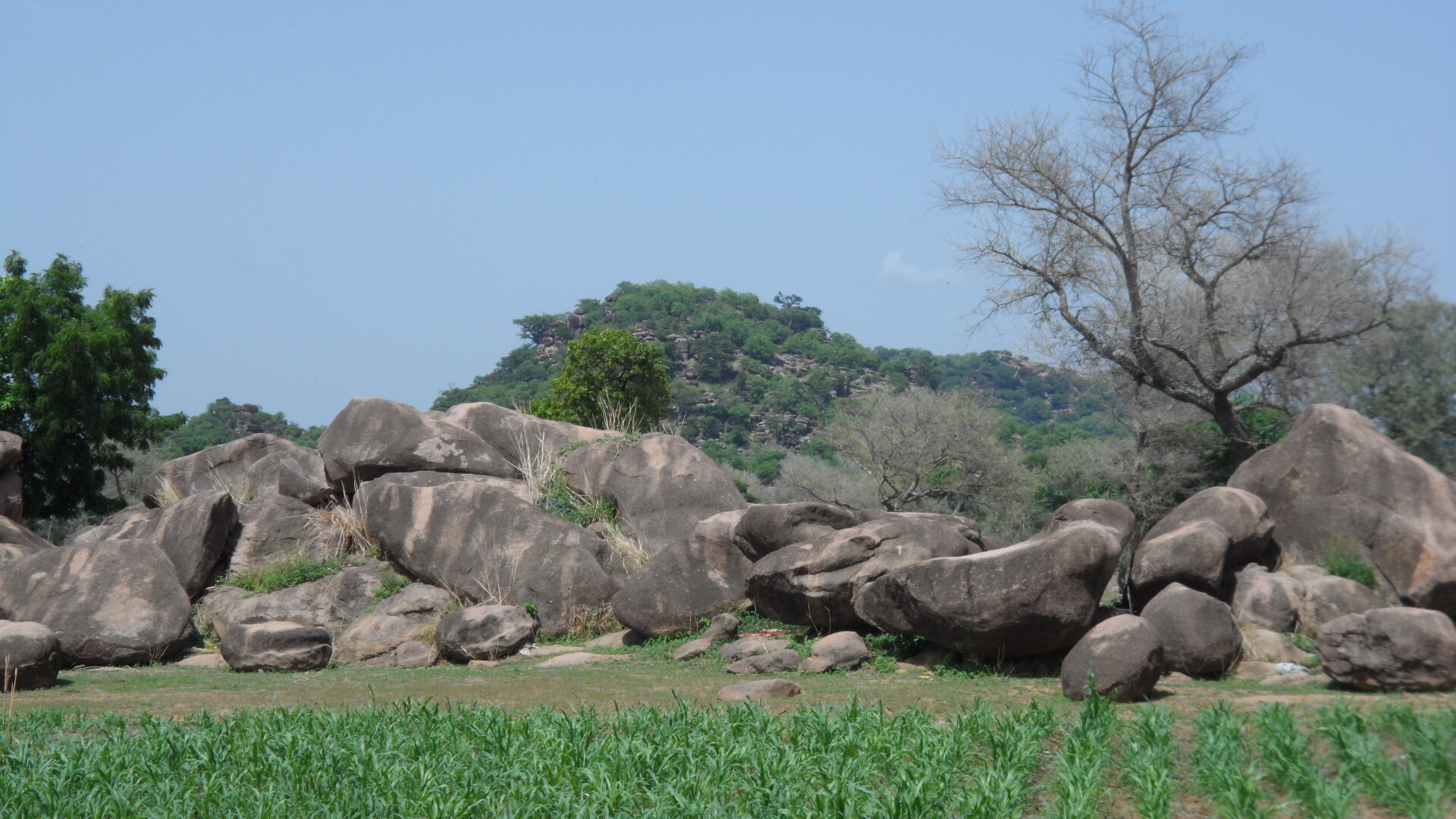
The north-east of Ghana is not a flat savannah with some stones lying about. Around Bolgatanga, out towards Bongo, and south-east through Talensi to Tongo, the land is built out of granite. Hills of stacked boulders rise out of the fields. Single rocks the size of houses stand between the compounds. Balanced stones sit on top of each other in ways that look impossible. Paths run between them, farms are fitted around them, and the round mud compounds are placed against them, not in spite of them.
And every big rock here is part of something. The rocks carry shrines, and they hold family and clan histories. They have been hiding places in times of raiding and war. If they start blasting in this country, they will not stop at one hill or two. The gold does not follow the heritage boundaries, and nobody has drawn those boundaries anyway.
The best-known part of this landscape has a name the world already recognises. The Tongo Hills and the Tengzug shrine complex of the Talensi people have been on UNESCO's Tentative List for World Heritage since 2000. The Tengzug shrine drew pilgrims from Asante and the colony's south. In 1931 the colonial government tried to move against its followers in the south, and J.B. Danquah intervened on their behalf. In 1934 the anthropologist Meyer Fortes began the fieldwork among the Talensi that made them one of the most studied peoples in Africa.
That is the landscape we are talking about. Not "some rock."
What "less damaging" means in granite
The President's comparison is with galamsey in the forest belt: rivers turned to mud and cyanide, forest reserves stripped, farmland dug into pits. Next to that, almost anything looks mild.
But hard-rock gold mining is not a gentle trade just because there are no trees to fell. Gold in rock usually comes in low grades, a few grams per tonne. To get it out you move enormous amounts of stone. In practice that means:
- Open pits. The hill is not "mined"; it is removed, and a hole is left where it stood.
- Blasting, with dust, noise and cracked compound walls for the villages around it.
- Crushing and chemical processing, usually with cyanide in the formal sector and mercury in the informal one.
- Tailings, millions of tonnes of ground rock waste stored behind dams, for decades.
- Water. Processing needs a lot of it, and the Upper East is one of the driest parts of Ghana, with a single rainy season and a long dry one.
- Resettlement. People living on top of the ore are moved away.
We do not have to imagine any of this. It is already happening in Talensi. The Cardinal Namdini mine, a subsidiary of China's Shandong Gold, is an open-cast mine with an initial life of fifteen years. It poured its first gold in November 2024. More than 1,000 people were resettled from its concession before commercial mining started.
A forest can, at least in theory, grow back. A granite hill that has gone through a crusher cannot.
The point in one sentence: in the south, mining destroys what grows on the land. In the Upper East, mining destroys the land itself.
It has already started
This is not a plan for some distant future. The Talensi area has been a gold district since the early 1990s, when local people began digging. A Chinese firm, Shaanxi Mining, arrived in 2011. By 2023 there were about 70 mining concessions in the Talensi constituency, and two companies held large-scale licences: Cardinal Namdini and Earl International Group.
That constituency is the same one that contains the Tongo Hills and Tengzug.
Local conflict has followed. In 2025 a community group organised protests against Cardinal Namdini over what residents were actually getting from the mine. The paramount chief, the Tongraan, publicly rejected claims that the companies were exploiting the area and said the community was involved in the negotiations.
So the President's words did not open a door. They announced that the door, already open, will be pushed wider, with the state's blessing.
What I could not find, and I say this honestly: a published concession map showing exactly which hills are licensed or planned for blasting, or any government statement that protects the Tongo-Tengzug landscape from it. That silence is itself the story. If the government has such a protection plan, it should publish it now.
Who wins the mining reset
Mining in Ghana is being rebuilt in 2026 under the banner of local ownership. New regulations require surface mining to be carried out by wholly Ghanaian-owned companies and underground mines to be at least half locally owned. Reuters reported that international miners, including AngloGold Ashanti, Newmont and Zijin, were told to move work to local contractors by December 2026.
Keeping more of Ghana's gold wealth in Ghana is a fair aim. The question is whose hands it ends up in.
The largest Ghanaian mining contractor is Engineers & Planners (E&P), founded by Ibrahim Mahama, the President's younger brother.
- On 7 April 2026 the Ministry of Lands and Natural Resources awarded the Damang mining lease to E&P, ending Gold Fields' thirty-year run there. The formal handover took place on 18 April. Critics questioned a tender process that allowed only seven days. The Minerals Commission points out that E&P's interest in Damang dates back to 2023, before the current government took office.
- In February 2026, at the Local Content Summit in Takoradi, the President himself promoted the Black Volta Gold Project, led by E&P, as a model of Ghanaian ownership. In August, on the same Upper East tour, he named the Black Volta development in Upper West as proof that formal mining creates jobs.
- In July 2026, Billionaires.Africa reported that E&P was defying a court order in a dispute over that same Black Volta mine, whose developer is Azumah Resources.
Is Ibrahim Mahama now the richest man in Ghana? Many Ghanaians say so. The honest answer is that nobody can prove it. There is no audited figure for his wealth, private estimates put it at around 750 to 800 million dollars, and the published rankings disagree with each other. E&P has existed since 1997, and his fortune was large long before 2025.
What can be said with certainty is this: under his brother's government, the rules of Ghanaian mining were rewritten in a way that favours large Ghanaian-owned mining firms, and the largest of them belongs to the President's brother. The President personally held up that firm's project as an example. And the President now says the rock of the Upper East is a fortunate place to mine.
No law requires a president to recuse himself from praising his brother's business. It should not need one.
Four years, five years, and the question nobody should dodge
All of this is happening while Ghana's Constitution is being reopened.
In December 2025 the Constitution Review Committee, chaired by Professor H. Kwasi Prempeh, recommended extending the presidential term from four to five years. The government has since accepted that proposal as part of a broader reform package. In June 2026, on his tour, the President said the term is too short for governments to deliver.
There are sensible arguments for a longer term. Many countries have one. But a term extension proposed by a sitting president raises one question above all: would it apply to the term he is serving now? Ghanaians are entitled to a clear, written answer, and they have not had one.
Then there is the third term. Ghana's Constitution limits a president to two terms, even if they are not consecutive, and this is John Mahama's second. The limit is an entrenched clause. Changing it would require a referendum in which at least 40 per cent of registered voters take part and at least 75 per cent vote yes.
In December 2025, Majority Leader Mahama Ayariga told Parliament that he kept hearing people say they wanted the President to stay beyond two terms. In July 2026, the NPP accused the President of a "veiled third-term agenda" linked to legal suits asking the Supreme Court to interpret Article 66. The President has publicly rejected any third-term ambition, and that denial is on the record here.
But talk about extending a mandate, in any form, has a way of creating facts. Look east. In March 2026 Somalia extended its presidential and parliamentary terms from four years to five. By June there was fighting in the streets of Mogadishu. Ghana is not Somalia. Ghana is Ghana precisely because every president since 1992 has left on time. That record is worth more than any gold in any rock.
What the government gets right
An honest article says this too.
The Mahama government repealed L.I. 2462, the regulation that had opened forest reserves to mining, keeping a campaign promise. Environmental groups called the repeal a major victory. It has pushed illegal miners out of reserves, and it has now admitted, openly, that the old approach failed because miners simply walked back in. Stationing soldiers in reclaimed reserves costs money and shows seriousness.
Formalising mining is also a better idea than pretending galamsey will vanish. Young people in the north need work, and a regulated mine with safety rules is better than an unregulated pit that collapses on them.
None of that answers the question of where. Saving the southern forest by opening up the northern rock country is not environmental policy. It is moving the damage to a region with less political weight, fewer journalists and drier land.
What must happen before a single charge is set
- Publish the map. Every existing and proposed concession in the Upper East, with boundaries, on a public website.
- Draw the heritage line first. A legal no-mining zone around the Tongo Hills, Tengzug and the other shrine landscapes, agreed with the Talensi and neighbouring communities before any new licence.
- Finish the UNESCO nomination. The Tongo-Tengzug landscape has sat on the Tentative List for twenty-six years. Nominate it properly.
- Real environmental hearings, held in the villages and in the local languages, not a notice in a gazette in Accra.
- Water first. No processing licence without a published water balance for a semi-arid region.
- Declare family interests. Every concession, lease or contract involving a relative of the President, published before approval, not discovered afterwards.
- A written answer on the five-year term: does it apply to the current presidency, yes or no?
The Upper East is not "fortunate" to have its gold in rock. It is fortunate to have a landscape that exists nowhere else in Ghana, and that no mine will ever give back.
Sources & references
- MyJoyOnline — Mahama on military detachments in forest reserves and gold "in rock" in the Upper East, August 2026
- UNESCO World Heritage Centre — Tenzug-Tallensi settlements, Tentative List
- Graphic Online — Talensi: rock shelters, shrines and gold (concessions and large-scale licences)
- MyJoyOnline — Cardinal Namdini pours first gold, open-cast mine in Talensi
- The Fourth Estate — Tongo's mining boom: the human cost
- Media Without Borders — the 2025 Talensi protest against Cardinal Namdini
- Billionaires.Africa — E&P and the Damang lease, April 2026
- Billionaires.Africa — E&P, the Black Volta mine and the court order, July 2026
- GBC — Mahama's five-point mining plan and the Black Volta Gold Project, February 2026
- Mongabay — Ghana repeals L.I. 2462
- The Sikaman Times — the government's position on the constitutional reforms, July 2026
- Ghana Fact — third-term narratives and the entrenched-clause route
- Citi Newsroom — NPP alleges a "veiled third-term agenda", July 2026
Connected reading
Updated and fact-checked: 17 September 2026.
Statements attributed to President Mahama are as reported by the sources listed. The description of the Upper East landscape is the author's own first-hand account. No published document seen by the author identifies a specific concession on the Tongo Hills or at Tengzug; this article does not claim one exists. Estimates of Ibrahim Mahama's personal wealth are unaudited and are given as reported. The allegation of a third-term agenda is the NPP's; President Mahama has publicly rejected it, and both positions are recorded. The report that E&P defied a court order is Billionaires.Africa's. This article makes no allegation against any person beyond matters already on the public record.
Written and researched by Remo Kurka · GhanaWeb-News.com