Laboma: Built Without Permits, Watched for Years, Flattened in a Day
Ghana 2026 · Accra · Demolitions · No sugar coating
Laboma: Built Without Permits, Watched for Years, Flattened in a Day (Video Below)
For years hotels, beach clubs and resorts rose on a filled-in mangrove lagoon beside the Labadi–Teshie road, in full view of every official who drove past. On Sunday 13 September 2026 the army's bulldozers arrived. The buildings are gone. The people who let them go up are still in their offices.
Sunday, 13 September
On Sunday morning soldiers of the Ghana Armed Forces' 48 Engineer Regiment, backed by police, moved into Laboma Beach in the La Dade-Kotopon Municipality. They brought excavators and bulldozers. By the end of the day beachfront nightclubs, hotels, restaurants and other hospitality buildings had been torn down.
The best-known casualty was the Pink Flamingo lounge, one of the most photographed beach venues in Accra. The notices served in August also named ULA Beach Club, Trophy, Bliss Escape, Amsterdam Kitchen, Si Beach Resort and Alora Beach Resort.
Owners and workers spent the day carrying out furniture, fridges, sound systems and anything else they could save before the machines reached them. Videos circulating on social media show substantial beachfront buildings coming down, not shacks.
The operation was carried out by the government's Post Flood Mitigation Task Force, led by Deputy Chief of Staff for Operations Stan Xoese Dogbe, with Brigadier General Okae-Yeboah of the Armed Forces coordinating on the ground. It followed a 21-day ultimatum served in early August by the Greater Accra Regional Security Council (REGSEC).
What Laboma was
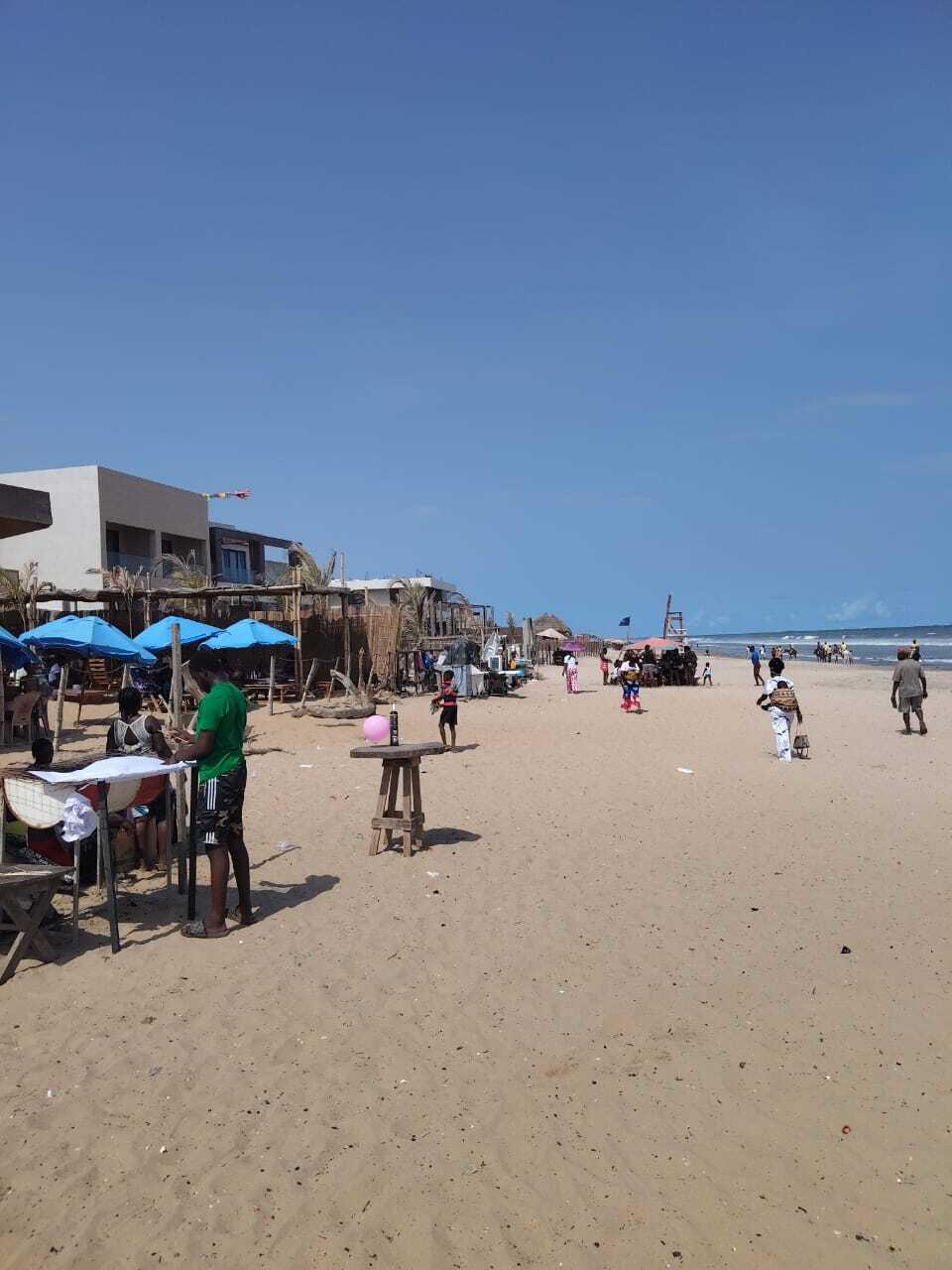
On this site's own guide to the beaches of Greater Accra, Laboma was one of the few places we recommended. That is not something we do lightly. Most of Accra's coastline is not a leisure coast: rip currents, no lifeguards, rubbish on the sand, no toilets worth the name.
Laboma, next to the La Beach Hotel, was one of the better stretches of the La coast. It was organised, with bars, restaurants, music and places to sit that were not falling apart. For many visitors, and for many young people from La and Teshie who worked there, it was one of the few parts of Accra's shoreline that actually functioned as a beach.
Laboma's board director, Daniel Okpoti, says the businesses there employed more than 3,000 people. Workers interviewed by Adom spoke of around 600 jobs at risk. The true figure probably lies somewhere between, depending on who counts cleaners, security guards, drivers and traders. Whichever number is right, it is a lot of livelihoods for one Sunday morning.
The government's case
An honest article has to put the other side fully, because it is not empty.
Laboma sits at the mouth of the Kpeshie Lagoon, one of the channels through which rainwater from the eastern part of Accra reaches the sea. According to the Greater Accra Regional Minister, Linda Ocloo, the area was once mangrove and wetland. Developers used heavy boulders to push into the lagoon, dumping rock into the water, covering it with sand and fill, and building on the new land.
The Regional Coordinating Council says its assessment linked the loss of the lagoon's floodplain to flooding at Tse Addo, an area that, according to the minister, had not flooded before. Accra suffered serious floods on 29 June 2026, and the task force has since demolished structures on waterways at the Tesa Dam, along Boundary Road in East Legon and at Oyarifa.
The government says the land will not simply be left bare. The Deputy Chief of Staff has directed the Regional Coordinating Council, the EPA and the Forestry Commission to replant the cleared strip with coconut and other trees and restore the wetland.
After the floods this country has lived through, "they built on a lagoon's flood basin" is not an argument anyone should wave away.
No permits, and everybody knew
Here is where the story turns.
This was not a secret. In March 2025, a year and a half before the bulldozers came, the La Traditional Council inspected Laboma and the lagoon together with the La Dade-Kotopon Municipal Assembly (LaDMA) and the municipal security council. The traditional leaders declared publicly that everyone developing there was an encroacher without a permit. The assembly's own engineer, Michael Boateng, said a search of the assembly's records had found that none of the developers at Laboma Beach and the Kpeshie Lagoon site held legal permits. The chairman of the local development trust said the lagoon had been reduced to a fraction of its former size, and that only 12 acres had ever been allocated on paper.
And the Regional Minister now says that some of the buildings were stopped at foundation stage, and the owners simply carried on.
Anyone who has built a house in Ghana will understand what that means. I have. When we built our own house in the Kpone area, the work could not continue without the permit. An ordinary family building a home gets stopped, and the paperwork gets checked.
At Laboma, meanwhile, multi-storey hotels, clubs with stages and sound systems, and resorts with restaurants went up on a main road, next to a well-known hotel, in one of the most visible spots in the capital. They ran openly for years. They advertised, drew crowds every weekend and were written up in guides like ours.
So the questions write themselves:
- If the assembly knew there were no permits, why were the buildings allowed to be finished?
- If developers were stopped at foundation stage and ignored the order, why was the order never enforced until the buildings were complete and full of staff?
- Did these businesses pay business operating fees, property rates or signage fees to the assembly? Did any hold liquor, tourism or event licences? If so, the state was collecting money from buildings it now calls illegal.
- Who in the assembly, the Lands Commission, the EPA or the Hydrological Authority signed off, looked away, or was paid to?
None of this makes the developers innocent. People who keep building after being told to stop, on filled-in wetland, took a risk with their eyes open, and some of them surely counted on connections to keep them safe. But a system that punishes only at the end, with bulldozers, after years of silence, is not enforcement. It is a lottery, and the losing tickets are held by the workers.
Who sold a lagoon?
The minister's own words contain the most important admission in this whole affair: somebody cut the mangroves, filled the land and sold it.
Wetland and lagoon margins cannot lawfully be sold as building plots. So who sold them? Which family, which stool, which land guard, which official? Who issued documents, if any? Who took the money, and how much?
As The High Street Journal asked, if this land was never available for development, what remedy does a buyer have against whoever sold it? Nobody in government has yet named a seller, opened an investigation or announced that anyone will have to repay anything. The buildings were demolished within five weeks. The land sales have not even been examined.
The pattern in one sentence: in Ghana the bulldozer arrives for the building, never for the person who sold the land, the official who ignored it, or the office that collected fees from it.
Only the floodplain?
The task force insists the operation did not cover the whole of Laboma, only structures identified inside the lagoon's floodplain. It also demolished a newly built wall along the Labadi–Teshie road, behind which vegetation had been cleared and fill was being dumped.
Laboma's management disputes the scale. Mr Okpoti says the Regional Minister, on her morning visit, acknowledged that work was going beyond the area originally marked. He also argues that water does not flow through the section where the businesses stood, and that if the low bridge is the bottleneck, it could be raised instead.
Nobody outside the task force has seen a published map of the buffer zone showing which buildings were inside and which were not. If the state demolishes by boundary, it must publish the boundary. Otherwise every owner along Ghana's coast and waterways has no way of knowing whether their building is next.
The people who pay
A woman who had opened a small business at Laboma told reporters she had taken a loan to do it.
She also said that she had suffered for the NDC, and now the NDC government had demolished her business. There is no compensation scheme. There is no relocation offer. There is no list of who lost what.
Even the opposition, which has little moral ground on demolitions, has spoken. Former Greater Accra Regional Minister Titus Glover warned that years of private investment and many jobs were being wiped out, and that technical alternatives should have been considered first.
Think about who actually worked at Laboma: waiters, cooks, cleaners, bar staff, DJs, security men, drivers, the women selling food outside the gate. Most of them are young and from La, Teshie and Nungua. None of them decided where the hotels would be built. All of them lost their income on the same Sunday.
Timeline
Over years: mangroves and wetland at the Kpeshie Lagoon mouth are cleared and filled with rock and sand; plots are sold; hotels, clubs and resorts are built.
March 2025: La Traditional Council and LaDMA inspect the site; the assembly's engineer says none of the developers holds a legal permit.
29 June 2026: serious floods in Accra; the Post Flood Mitigation Task Force begins demolitions on waterways.
24 July 2026: demolitions along the Tesa Dam and the Legon Boundary Road watercourse.
5–7 August 2026: REGSEC monitoring visits; a 21-day notice is served on Laboma occupants, including the Pink Flamingo.
13 September 2026: the 48 Engineer Regiment demolishes structures at Laboma.
After 13 September: the government orders replanting and wetland restoration; Laboma's management calls for a halt; no compensation, no published boundary map, no investigation into the land sales.
Verdict
Two things are true.
The lagoon matters. Accra floods because its wetlands, lagoons and drains have been filled and built over. A government that finally defends a flood basin is doing something previous governments did not.
And the way it was done is a failure of the Ghanaian state, not just of the developers. The state knew for years. It had its own engineer confirm there were no permits. It stopped buildings at foundation stage and then let them rise. It let them trade, advertise and employ hundreds or thousands of people. Then it sent the army with three weeks' notice, no compensation, no published map, and not one question for the people who sold a mangrove swamp as building land.
Millions of cedis of investment, a working beach that was one of Accra's few recommendable ones, and a large number of jobs are gone. If nobody who sold, approved, ignored or collected money from Laboma is ever named, the next Laboma is already being filled in somewhere else along this coast. And the bulldozers will come for that one, too, only when it is finished.
We will update our Greater Accra beaches guide accordingly. Visitors should not assume that anything they read about Laboma before September 2026 still stands.
Sources & references
- The Presidency, Republic of Ghana — Kpeshie Lagoon clearing enters enforcement phase, 13 September 2026
- Graphic Online — Laboma Beach structures demolished to restore natural water flow
- Graphic Online — REGSEC gives 21-day demolition notice to Laboma encroachers (affected businesses named)
- GBC — Task force demolishes illegal structures at Laboma to restore Kpeshie Lagoon
- GBC — Deputy Chief of Staff directs wetland rehabilitation after the Laboma clearance
- Ghanaian Times — La Traditional Council warns encroachers at Laboma and the Kpeshie Lagoon, March 2025
- MyJoyOnline — Demolition begins at Laboma; minister says developers ignored stop orders
- Adom Online — Laboma director appeals for a halt
- The Ghana Report — over 3,000 livelihoods affected, says Laboma director
- UA.News (citing MyJoyOnline) — director disputes the scale of the demolition
- Adom Online — residents and workers fear loss of livelihoods
- The Ghana Report — Titus Glover on livelihoods and investment
- MyJoyOnline — "Who approved Laboma structures?" Victoria Bright calls for a review of permitting
- The High Street Journal — any remedy for the purchaser of "illegal" land?
- The High Street Journal — negligent authorities and corner-cutting developers
Connected reading
Updated and fact-checked: 17 September 2026.
Statements by officials, the Laboma management and affected workers are given as reported by the sources listed. The figure of more than 3,000 jobs comes from Laboma's management; workers quoted by Adom spoke of about 600. The claim that demolition went beyond the originally designated area is Laboma management's, citing the Regional Minister; the task force states that only structures within the floodplain were affected. Both positions are recorded. The notice date is given as 6 or 7 August 2026 in different official and media reports. The author's reference to building permits in the Kpone area is his own experience. This article names no person as having sold land or taken payments, and makes no allegation beyond matters on the public record.
Written and researched by Remo Kurka · GhanaWeb-News.com