The Video From Tripoli: What Ghana's President Said About Travelling, Seventeen Months After Closing the File
The Video From Tripoli: What Ghana's President Said About Travelling, Seventeen Months After Closing the File
Two summits, two cities in Libya, seventeen months apart. At the first, Ghana signed the document that ended the case of forty-four citizens killed on their way to Europe. At the second, the President of Ghana was asked about Ghanaians who travel. We hold the footage from the second one, and as far as we can establish, nobody else has published it.
This article is a companion piece. The full account of what happened in The Gambia in July 2005, and of what Ghana did about it, is published separately on this site.
This one is about eleven seconds of a president speaking, and about why the date matters more than the words.
The first summit: Sirte, 2 July 2009
The African Union met at Sirte, on the Libyan coast, from 1 to 3 July 2009.
There, on 2 July 2009, the governments of Ghana and The Gambia signed a Joint Communiqué ending the dispute over the deaths and disappearances of Ghanaian nationals in The Gambia in 2005.
It recorded that the Gambian government was not complicit. It provided for contributions to the families as a humanitarian gesture rather than as compensation. It contained a pledge by both governments to pursue by all available means the arrest and prosecution of everyone involved.
The United Nations Secretary-General issued a statement the same day, welcoming the fact that two African states had settled their differences peacefully and through negotiation.
President John Evans Atta Mills had been in office for just under six months. No arrest has ever been made under that pledge, by either government, in the seventeen years since.
The second summit: Tripoli, 29–30 November 2010
Seventeen months later, Libya hosted again — this time the Third Africa–EU Summit, in Tripoli, on 29 and 30 November 2010. Around eighty heads of state and government attended, under the theme of investment, economic growth and job creation.
Migration was explicitly on the agenda. The summit adopted the Tripoli Declaration and, with it, the second action plan of the Africa–EU Partnership on Migration, Mobility and Employment, covering 2011 to 2013. Alongside peace and security, climate, energy, agriculture and food security, the movement of African people towards Europe was one of the standing items that European and African leaders had come to discuss.
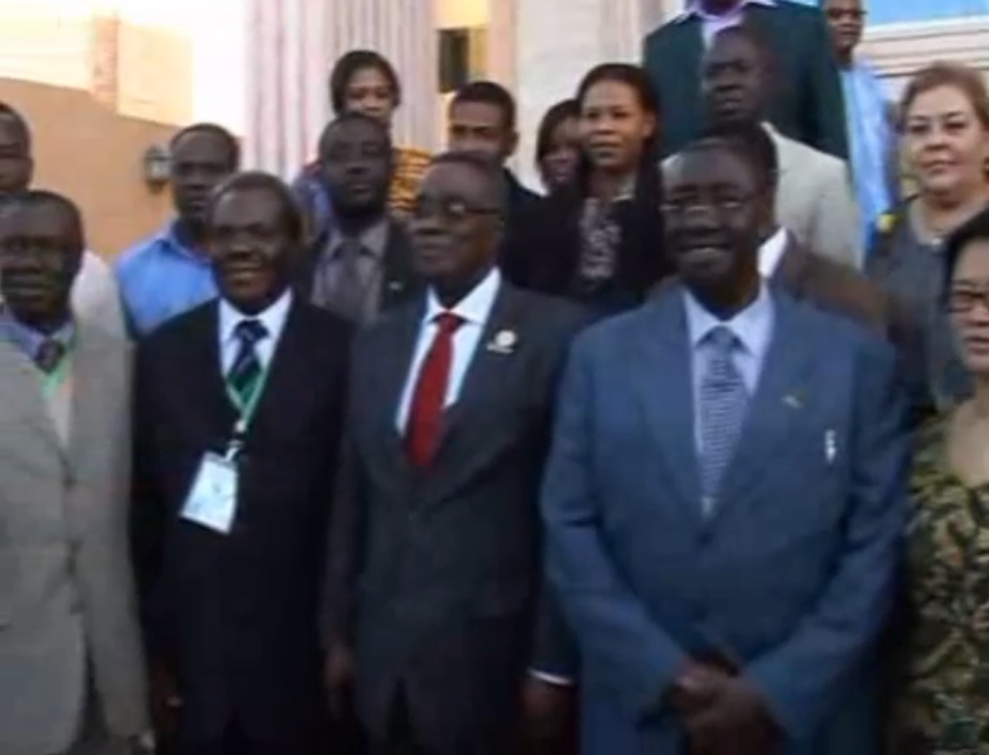
President Atta Mills was there. Our footage is from that summit.
“We don't say, that Ghanaians must not travel, but please make sure, you have the right papers. As a government we make sure, that we protect our citizens.”
President J.E. Atta Mills, Third Africa–EU Summit, Tripoli, 29–30 November 2010. Transcribed from footage held by this network.
Why we are not calling this a scandal
Let us be careful, because this article is about accuracy.
The President was not asked about The Gambia, and he was not talking about the forty-four. He was at a migration summit, answering the question that summit existed to answer: what African governments say to their own young people about irregular movement towards Europe. Every West African head of state at that table said some version of the same sentence that week.
Taken on its own, it is unremarkable. Governments do advise citizens to travel documented. Ghana has consular services, it issues passports, and a head of state saying so at an EU summit is doing his job.
What makes it worth publishing is the calendar, and what the second half of the sentence claims.
The problem with the second half
“As a government we make sure, that we protect our citizens.”
Seventeen months earlier, that same government had signed a document in the same country accepting that no Gambian state actor was responsible for the deaths of forty-four Ghanaians — on the basis of an investigation report that has never been published to this day, not to the families, not to the public, and not in response to requests from five United Nations human rights experts.
Ghana's own foreign minister at the time was on record as sceptical of that report. He signed anyway, to close the matter and repair relations with Banjul.
Nine years later, former members of the Gambian death squad would describe on live television how they carried out the killings, and The Gambia's own truth commission would find that the orders came from the president and that the cover-up was organised.
The men who died in July 2005 did not die because of paperwork. Their documents were never the issue. They were detained because a foreign president had been told mercenaries were coming by sea, and they were killed because a unit answering to him was told to deal with them.
No travel advisory would have saved them. A government that protected its citizens might have.
What Ghana was doing about migration in that period
It is worth setting the Tripoli remarks in their proper policy context rather than pretending they came from nowhere.
By 2010 the Africa–EU relationship on migration was already three years old, dating from the Joint Africa-EU Strategy adopted at Lisbon in 2007 and the Tripoli Declaration on Migration and Development of 2006. The framework was built around better management of flows, cooperation against trafficking, and — in the European reading — reducing irregular arrivals.
African governments came to those meetings under pressure to take responsibility for their own emigrants, and the standard response was exactly the one in our footage: we will not stop our people travelling, but we will encourage them to do it legally.
That is a policy position, and it is defensible. What it is not is protection. Advising a twenty-four-year-old from Kumasi to obtain a visa he will never be granted is not a consular service. And when the same government has just accepted, in writing, a finding that nobody was responsible for the deaths of forty-four young men who made that journey, the phrase about protecting citizens carries a weight it cannot hold.
Why this footage exists at all
This network has been archiving Ghanaian material since December 2000. The Atta Mills audio and video collection on our sister site includes his New Year message, his assurance to the world on the 2012 elections, the Accra–Tema rail line commissioning, the first national science congress, the naval vessels, the unannounced inspection at the customs offices in Tema, and the Tripoli summit.
Most of it was produced by the Presidency and most of it has since disappeared from the places it was originally posted. Material from African governments has a survival problem: it is published on state platforms, the platforms are replaced, and nothing migrates.
We keep it because somebody has to. Twenty years on, a two-minute clip of a head of state at a summit is not nostalgia. It is evidence about what was said, when, and in what room.
What we are asking
Not for a posthumous verdict on President Atta Mills. He died in office in July 2012, he inherited this file rather than created it, and the decision to accept the 2009 report was taken by a government and a foreign ministry, not by one man in a press scrum.
We are asking three specific things, and they are all answerable in 2026.
- Publish the April 2009 UN–ECOWAS report. Ghana is a party to it. Every official Ghanaian position on this case since 2009 rests on a document that no Ghanaian is permitted to read.
- State whether Ghana still stands by its conclusion, given the sworn testimony that has since contradicted it.
- Fund the Special Tribunal for The Gambia and press for the surrender of the accused. More Ghanaians died in this crime than citizens of any other country. The court exists. It has no money and no defendant.
Foreign Minister Samuel Okudzeto Ablakwa raised accountability for the 2005 killings with his Gambian counterpart in May 2026. That is the first movement on this file in years, and it is the right moment to ask.
The two dates, one more time
- 2 July 2009, Sirte, Libya — African Union summit. Ghana and The Gambia sign the Joint Communiqué. The case is closed on the basis of an unpublished report. Both governments pledge to pursue arrests and prosecutions.
- 29–30 November 2010, Tripoli, Libya — Third Africa–EU Summit, with migration on the agenda. President Atta Mills tells Ghanaians to travel with the right papers, and says the government makes sure it protects its citizens.
- September 2026 — No arrest. No prosecution. No published report. No recovered remains. The Special Tribunal has no funding and no hearing date.
Sources & references
- Ghana-Net.com — the Atta Mills audio and video archive, including the Tripoli summit footage
- United Nations — the Secretary-General's statement on the Joint Communiqué signed at Sirte, 2 July 2009
- The Third Africa–EU Summit, Tripoli, 29–30 November 2010 — theme, participants and agenda
- International Organization for Migration — the Africa–EU Partnership on Migration, Mobility and Employment and the second action plan adopted at Tripoli
- The Tripoli Declaration adopted at the close of the summit
- European Commission — briefing memorandum on the Third Africa–EU Summit
- Human Rights Watch & TRIAL International — the July 2005 killings and the 2009 settlement
- TRIAL International — the April 2009 UN/ECOWAS report and why it has never been made public
- Graphic Online — Ghana renews its push for justice, May 2026
Published and fact-checked: 14 September 2026.
How this article was checked. The African Union summit at Sirte from 1 to 3 July 2009, the signing of the Joint Communiqué between Ghana and The Gambia on 2 July 2009 and the United Nations Secretary-General's statement of the same date, and the Third Africa–EU Summit held at Tripoli on 29 and 30 November 2010 under the theme of investment, economic growth and job creation — at which the Tripoli Declaration and the second action plan of the Africa–EU Partnership on Migration, Mobility and Employment were adopted — are as recorded in the sources listed above. The remarks attributed to President J.E. Atta Mills are transcribed from video footage held and published by this network, originating from the Presidency of the Republic of Ghana and recorded at the Tripoli summit; the footage is linked above and readers can verify the transcription against it. This article does not assert that the President was asked about, or was referring to, the killings in The Gambia in 2005, and no such claim should be read into it; the two events are presented in their documented chronological relationship and nothing more. The April 2009 joint United Nations–ECOWAS report has never been published, despite requests from the victims' families and from five United Nations human rights experts. Yahya Jammeh has not been charged, tried or convicted by any court and denies wrongdoing. This article makes no allegation against any living person beyond matters already on the public record.
Written and researched by Remo Kurka · ghanaweb-news.com