Labadi Beach Demolition 2026: Who Ordered It, and Why Now?
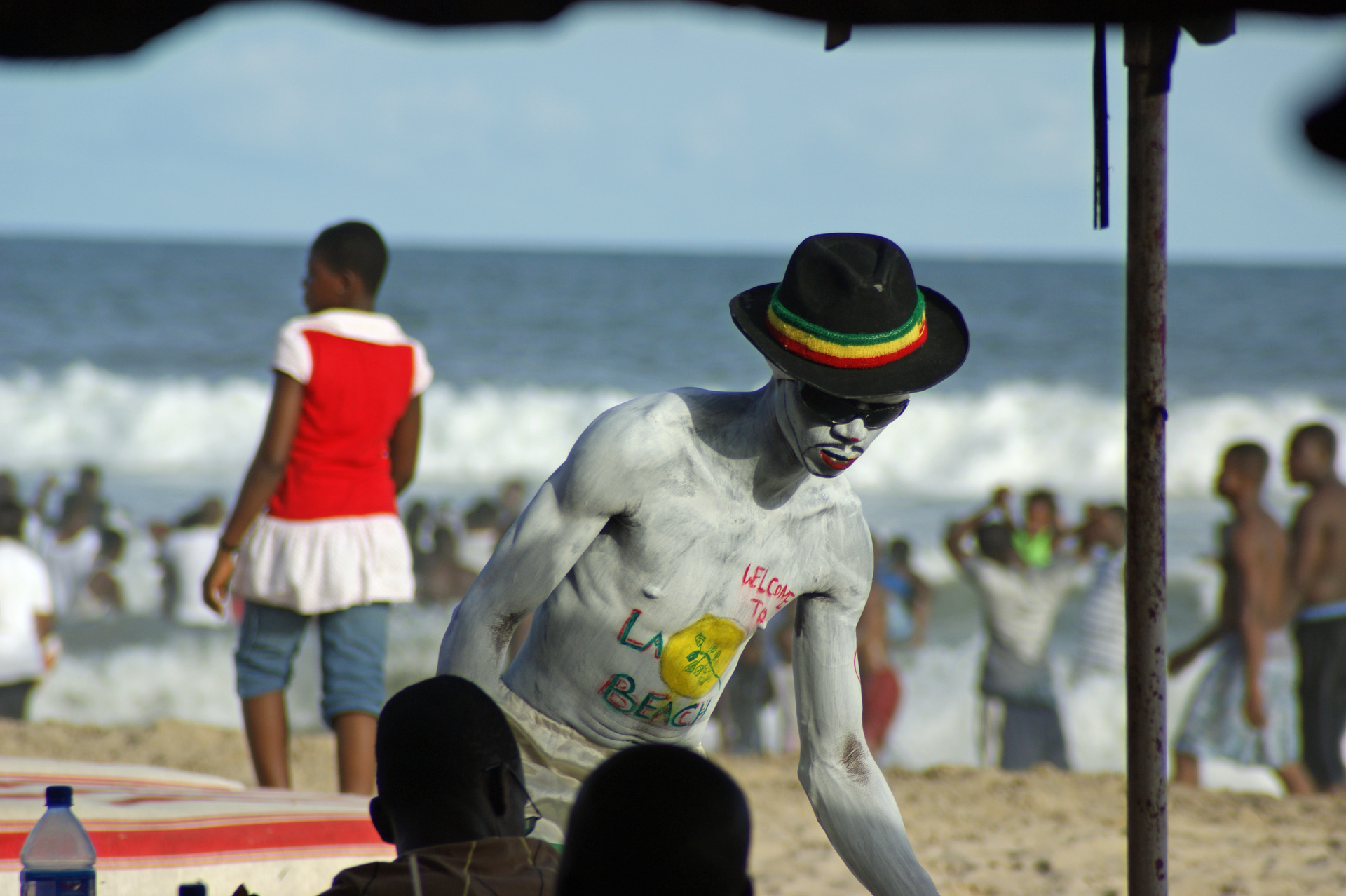
Ghana Tourism News · Accra · 6 October 2026
Labadi Beach Flattened at 4am: SSNIT, National Security and a Story That Does Not Add Up
Soldiers, police and bulldozers cleared Accra's best-known beach before dawn on 2 October 2026, while the ownership of the land was still before a court. The Presidency says it was not a government action. The state pension trust says it asked for it. Ghanaians are not buying either version.
By Remo Kurka · First report · Full photo and video report to follow
Four o'clock in the morning
At about four in the morning on Friday, 2 October 2026, a joint force of soldiers and police moved onto La Pleasure Beach, the stretch of Accra coast the world knows as Labadi Beach. Men of the 48 Engineer Regiment, the Military Police, the Fifth Battalion and the Ghana Police Service ordered workers, bar owners and those who sleep on site to leave. Many were given minutes, not hours, to take what they could carry. Then the machines started.
By daylight, Polo Beach Club, Vienna City Club and Pera Beach lay in rubble, along with rows of bars, shops, stalls and pub sheds. Workers stood crying in the sand. One single mother said they had been told two weeks earlier to start packing, but nobody believed it would really happen. The MP for La Dadekotopon, Rita Naa Odoley Sowah, arrived and confronted the soldiers. She accused them of firing shots and pointing guns at people, and asked the question that has become the question of the week:
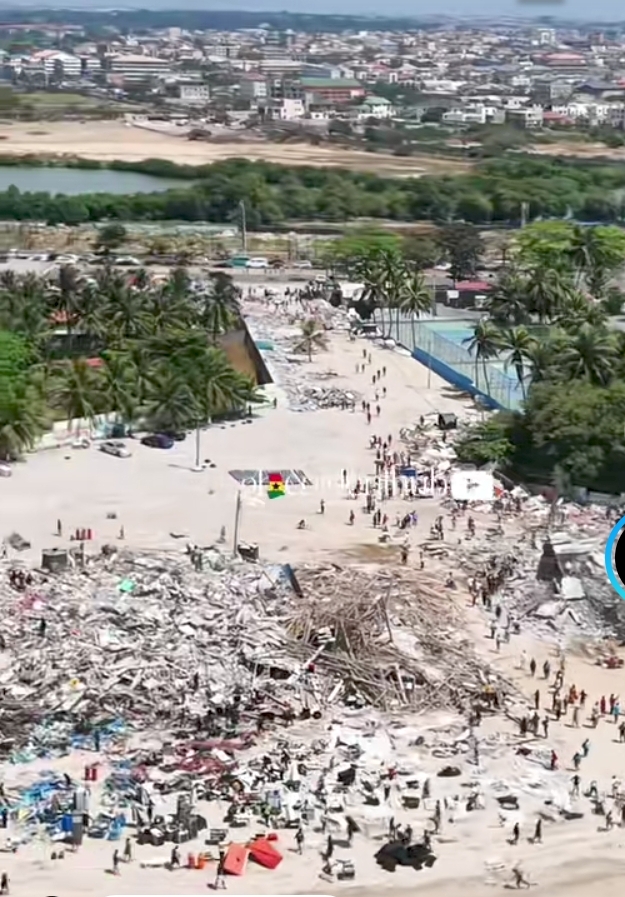
This is the second big Accra beach flattened in under three weeks. On 13 September the same engineer regiment demolished more than twenty structures at Laboma Beach. Laboma was officially about floods. Labadi, the government now insists, was not.
"Not a government action"
Within hours, Deputy Chief of Staff Stan Dogbe, who also leads the government's Anti-Flood Taskforce, wrote on Facebook that the operation was not a flood-mitigation exercise. It had been carried out under the supervision of National Security at the request of the Labadi Beach Hotel, he said, because Polo Beach Club and other structures in front of the hotel were damaging its safety, tranquillity and reputation. Then he asked his readers whether the hotel was not right to reclaim its beachfront.
In the same breath he added a line that has been thrown back at him ever since:
Yet La Pleasure Beach is exactly what now lies in ruins.
So let us be precise about what "not a government action" means here. The soldiers were the state's soldiers. The police were the state's police. The operation was supervised by the state's National Security Council Secretariat. And the hotel that asked for it is owned by the state's own pension trust. One TikTok viewer put it better than any press officer:
SSNIT: the pension fund that called in the army
On the same day, the Board of Trustees of the Social Security and National Insurance Trust confirmed that it had itself asked the National Security Council Secretariat to step in. Its complaint was what it called persistent unlawful occupation and encroachment in front of the Labadi Beach Hotel and the La Palm Royal Beach Hotel, both SSNIT properties. Its list of reasons runs from guest security, fire risk and sanitation to the privacy expected at international hotels. And its justification fits in one sentence:
The workers of Ghana also include the cooks, waiters, drummers, security men, horse boys and bar owners who lost their workplace that morning. Many of them are SSNIT contributors too.
SSNIT promises the beaches will be cleaned, restored and kept open to the public. It has not said what "restored" means, who will be allowed to trade there and at what price, or whether anyone will be compensated.
Nor is the Labadi Beach Hotel a struggling business in need of rescue. SSNIT's Director-General, Kwesi Afreh Biney, told Parliament's Public Accounts Committee that the hotel made about GH¢80 million profit in 2024. In June 2026 he went further, saying discussions were already under way to expand the hotel and add rooms. An expansion needs land. On a coastline, the obvious land is the beach.
A government MP who says the government did not know
Rita Naa Odoley Sowah is no opposition firebrand. She is the NDC MP for La Dadekotopon and a sitting Deputy Minister for Chieftaincy and Religious Affairs. She says she went to the authorities beforehand and was assured that Labadi Beach would not be touched. On the morning itself, the hotel's Managing Director told her he knew nothing about the operation. Its board chairman, by contrast, told her it would go ahead because the land belonged to the hotel. Her chiefs, she says, never gave that land to the hotel.
So either a deputy minister was misled by her own government's security apparatus, or the government knew. There is no third version in which anybody comes out well.
Why now, after more than 25 years?
This is the question every Ghanaian is asking. Bars, drummers, horse riders and food sellers have worked this beach for decades. I photographed them in 2002, 2004 and 2008, and again in 2015, 2023 and 2025. Every authority knew they were there. Guidebooks, tour operators and the hotels themselves sold Labadi to the world precisely because of them. So what changed? Put in order, the public record gives a fairly clear answer.
2019 Polo Beach Club opens on the beachfront, at first as a joint venture with the Labadi Beach Hotel, using the hotel's entrance. The club is linked to Kwame Blay, son of former NPP National Chairman Freddie Blay.
June 2022 The club says it takes a 20-year lease of the beachfront from the La Stool for GH¢1.5 million, with the consent of the La Pleasure Beach Management Committee. A 2023 valuation puts the building alone at GH¢41.3 million.
2024 Then-opposition MP Samuel Okudzeto Ablakwa accuses the Blay family of trying to capture the hotel's beachfront. He also fights SSNIT's plan to sell 60% of its hotels to Rock City Hotel, owned by then-minister Bryan Acheampong, calling it state capture. The pensions regulator orders the sale suspended.
June and December 2024 The hotel sues the club over the beachfront. In December the High Court grants the hotel an injunction against the club's company.
June 2026 SSNIT says it will sell none of its hotels and is in talks to expand the Labadi Beach Hotel.
18 August 2026 Polo Beach Club officials are summoned to the National Security Secretariat. According to the club, they are told the demolition requested by the hotel is "non-negotiable and irreversible", with only a small compensation in prospect. One of the grounds given is that the hotel needs the area for expansion.
13 September 2026 Laboma Beach is demolished.
16 September 2026 The hotel withdraws its own court case. Within hours the club sues the hotel, National Security's Director of Special Operations, Richard Jakpa, the National Security Coordinator and the Attorney General. La Pleasure Beach management refuses a 24-hour order to vacate, arguing the ownership dispute is before the courts.
2 October 2026, 4am The bulldozers arrive.
Read in that order, the story tells itself. A hotel with a declared expansion plan withdraws its own lawsuit. A land dispute is still open before a High Court judge. And a security operation settles it before sunrise. The lawyer Samson Lardy Anyenini had publicly urged the authorities not to demolish before the court had ruled. They demolished anyway.
The other side deserves no halo either. Polo Beach Club was no village bar but a big-money venue tied to a powerful political family, and a court had already restrained its company in 2024. Freddie Blay now claims President Mahama personally ordered the demolition, an allegation nobody has independently established. NPP flagbearer Mahamudu Bawumia says the beach was demolished "so wantonly" and promises leases to every business. Both parties are now fighting over the rubble. But the people who lost most on 2 October were neither the Blays nor SSNIT. They were the ordinary workers of La.
Beaten for filming
Soldiers pushed journalists and bloggers back from the site. Video shared on social media shows the activist Ralph St Williams being assaulted by soldiers. The blogger Sika Official (Kwaku Dennis Sika) says a soldier struck him with a rod. The New Media Association of Ghana has called on the Ghana Armed Forces to investigate, and accounts of further assaults on traders and workers have followed.
In the days since, statement videos posted on TikTok appear to show more people, among them foreign business owners who worked on the beach, displaying injuries they say were caused by soldiers. These are personal testimonies and have not yet been independently verified. ghanaweb-news.com is collecting and checking them for the full report.
A beach clearance is not a war. Firing warning shots and beating people with rods over bar sheds is not the "orderly management" of a tourism destination. It is the opposite.
What Ghanaians are saying
Read the comments under the TikTok videos of the demolition and the official story falls apart quickly. A selection, quoted as written:
Not every voice is angry. A few applaud "functional urban planning", and some hint that not everything happening on the beach at night was innocent. But they are a small minority. Most commenters see the same thing: the poor removed, the powerful protected, and no plan for the day after.
Who was there first?
One argument comes up again and again: La Pleasure Beach was there long before the hotels. That much is plainly true. People were swimming, drumming and trading on La's shore long before Ghana existed as a state, and the Labadi Beach Hotel only marked its 35th anniversary this year. The hotel walls tell their own story too. They stop where the sand begins.
One long comment, apparently from someone close to the La side, goes further. It claims the hotels approached the La Traditional Council for access to a marked-off section of beach on short, renewable leases at small yearly fees, reportedly as little as GH¢2,000. A few structures inside that section were to be cleared. Instead, the comment says, the whole beach was flattened with political backing.
The simplest test is the one a TikTok commenter proposed. If SSNIT's land title includes the beach, publish the site plan. If it does not, the "unauthorised occupants" were never on SSNIT's land.
Two months to Christmas
Then there is the timing. The demolition came at the start of October, two months before the December season. Those are Labadi's busiest weeks, when the diaspora flies home and beach businesses earn a large share of their year. Polo Beach Club itself is best known for its festive-season events. All over social media, Ghanaians ask why it could not at least have waited until January. Nobody in authority has answered. Whether the date was chosen to kill the December season before it began is a question SSNIT and National Security owe the public an answer to.
A beach for whom?
The biggest fear on the street is not about Polo Beach Club. It is about what comes next. Many people believe the cleared sand will return as a polished hotel frontage, with expensive restaurants and terraces priced for conference delegates and NGO staff. That would mirror the two hotels themselves, where a night was always beyond ordinary Ghanaians and even a meal has become a luxury. SSNIT says the beach will stay open to the public. But open is not the same as affordable. A beach where a Ghanaian family can no longer buy a drink, a plate of kelewele or a horse ride is open in name only.
This would not happen like this in Europe
I divide my year between Ghana, Germany and Wales. In Europe, businesses that have traded openly for decades, paid fees and been tolerated by every authority cannot be flattened overnight by soldiers. Removal needs a lawful, enforceable decision, proper notice, the right to appeal and, very often, compensation. And while ownership of the land is before a court, everyone waits for the judge. In Accra on 2 October the court case was still open, and the army decided it.
Questions SSNIT and National Security must answer
- Who, by name, ordered the demolition of La Pleasure Beach, which Stan Dogbe says his remarks did not cover?
- Why did the hotel withdraw its own lawsuit on 16 September, and why did National Security act while the club's case was still pending?
- Does SSNIT's land title include the beach? If so, publish it.
- What exactly does SSNIT plan to build, and will the La community, its chiefs and its workers be consulted?
- Why early October, two months before the December season?
- Who authorised warning shots, and will the soldiers who beat journalists and workers be investigated?
- If the structures were "unauthorised" for 25 years, who collected the fees, granted the permits and looked away all that time?
- What compensation will the people who lost their livelihoods receive, and when?
Where to go now
For visitors: Labadi is not a beach to visit right now. Bojo Beach, west of Accra, is the best day option near the city. Kokrobite remains the choice for music and overnight stays, and Sakumono for a quieter break east of the city. Check before you go, because this year no Accra beach can be considered safe from the bulldozers. My updated beach guide is at ghana-net.com: Greater Accra beaches.
Accra and coastal tours
Guided Accra and coast tours are an easy way to see the city's beaches, forts and markets with a local guide. Entrance fees are included in the tour price; tips are not included but always welcome.
This is the first report. The full story, Labadi through 25 years of my own photographs and video from 2002 to 2025, together with the testimonies from the demolition, follows in Labadi: Twenty-Five Years On, Accra's Beach Flattened Before Dawn.
Verified and fact-checked: 6 October 2026. Sources: Graphic Online, MyJoyOnline, Citi Newsroom, GhanaWeb, 3News, Adom Online, Modern Ghana, Ghanaian Times, YEN.com.gh, Ghana News Agency, the SSNIT Board of Trustees statement of 2 October 2026, and public comments on TikTok. Comments are quoted unedited and without names.